

A Winter Blessing
Under candlelight and flicker, guided by the spirit of poetry, and the tradition of Celtic Blessings, a group of Poetry Salon participants created a collective blessing for the world. In an act of daring, gentle beauty, as each participant was reading their line aloud, I imagined the ripple effect of their compassion and care spreading out, illuminating pathways through these dark times.
Below the blessing, with an invitation. What line would you add?
Here was ours, written on Winter Solstice, December 21st 2023, with participants from Ireland, UK, Spain, Portugal, US, Belgium and Switzerland
Under candlelight and flicker, guided by the spirit of poetry, and the tradition of Celtic Blessings, a group of Poetry Salon participants created a collective blessing for the world. In an act of daring, gentle beauty, as each participant was reading their line aloud, I imagined the ripple effect of their compassion and care spreading out, illuminating pathways through these dark times.
Below the blessing, with an invitation. What line would you add? (you can add in the comments below)
Here was ours, written on Winter Solstice, December 21st 2023, with participants from Ireland, UK, Spain, Portugal, US, Belgium and Switzerland.
Collective Blessing, written by Salon participants
May we allow ourselves rest in the “in between”.
May we remember that we belong to each other.
May we honour the self in ourselves and each other.
May we be the mystery keepers at the crossroads of our senses.
May we pull down the curtain embroidered by those who would keep us apart to quell our power.
May our current darkness birth life and light in the world and in us.
May the people of Gaza have clean water, shelter, medical care, enough to eat and freedom to live without bombs.
May the cycles of life fall gently on you, may your storms be few with many shelters.
May we all the remember our hearts being blessed.
May we accept the protection of our wild waiting kin.
May there be light to open humanity’s dark mind and see what really is.
May we become a sanctuary for ourselves and for others.
May we all turn towards the love in our hearts, and from this place of peace, bless love as the guiding force in the world.
21 December, 2023.

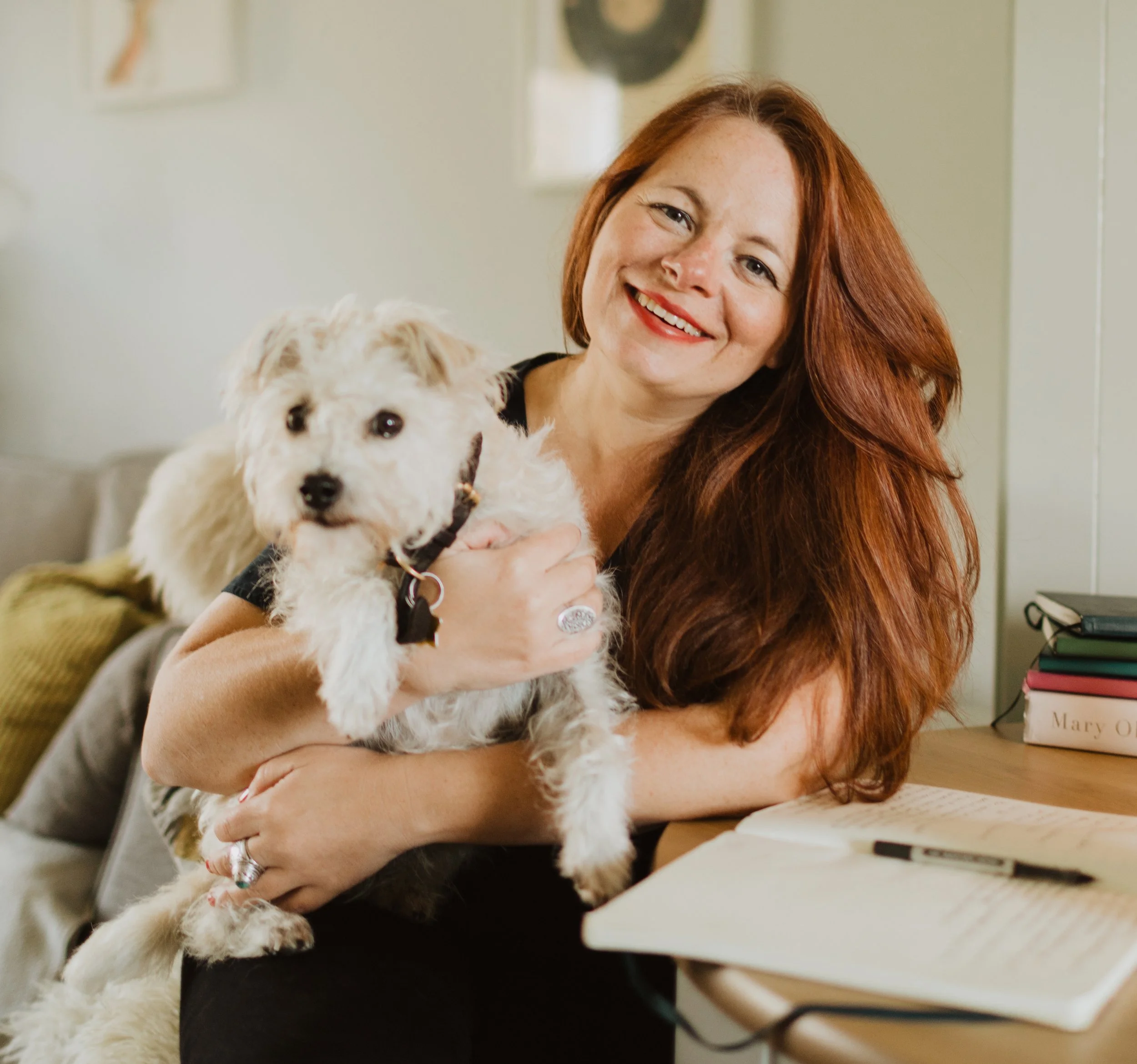
Hello. I'm Clare
I'm a writer, educator and facilitator, living in beautiful West Cork, Ireland. I love to share resources and learning to help harness the regenerative power of words, place and story. I hope my work offers nourishment for mind and soul. Thank you for being here. Clare x

Available Now
An Intentional Year
Focus on what matters most, and create an intentional 2024. Guidebook and an Intentional Year course now available


Winter Solstice Prompts
But what does it mean to cultivate hope?
One of the origins of hope is pause. To sit still in the fullness of our lives and give ourselves back to the magic of joy, generosity and to the dream of better days to come- for to be hopeful is to have belief in the possibilities of the future, as individuals and as a collective.
The word solstice comes from the Latin, meaning, Sol (sun) + Sistere (to stand still). And so, I invite you to take a few moments of pause, to sit with the questions of the turning of the season, still honouring the dark while calling in the light, a way to cultivate your own sense of hope in these turning times.

December is deep upon us and here in the Northern Hemisphere the days are short and the nights are long. However, celebrated around the eve of the 20th December, the Winter Solstice is a turning point in the year, where a reversal in the light happens and the days begin to lengthen. It is not surprising then that many ancient and religious festivals take place around this time of year, for the solstice represented a renewal of hope and a reminder that the light would return and with it the warmth required for the seeds of new life to germinate. As the light arrived our ancestors knew the tide of the year would turn too.
In ancient times in Ireland, this magical turning was reflected in the architecture of the day. Newgrange in Co. Meath is perhaps the best known example of this, when, at dawn, the soft winter light is tunnelled down a long passageway to light up a burial chamber. It’s a remarkable feat of science and engineering, and hints to the mysticism and magic embedded in their honouring of the natural cycles of the year.
Christmas has long been associated with magic. Santa, flying reindeer, presents left under trees are modern day embodiments of these ancient practices of honouring this time of year- a time of giving thanks, of joy, of hope and yes, magic. And yet, for many Christmas is a hard time, the financial pressures of an overly commercialised festival, the missing of loved ones and absent friends, or even the deeper struggles to find a home in the wider place in the world, can all be amplified at this time of year.
Switching on the global news headlines does not seem to help either- one would not be alone in giving oneself over to cynicism. Hope then, in these days of uncertainty and fear becomes even more powerful and more urgent.
But what does it mean to cultivate hope?
One of the origins of hope is pause. To sit still in the fullness of our lives and give ourselves back to the magic of joy, generosity and to the dream of better days to come- for to be hopeful is to have belief in the possibilities of the future, as individuals and as a collective.
The word solstice comes from the Latin, meaning, Sol (sun) + Sistere (to stand still). And so, I invite you to take a few moments of pause, to sit with the questions of the turning of the season, still honouring the dark while calling in the light, a way to cultivate your own sense of hope in these turning times.
Prompts for honouring the dark:
This is a time of year when the light is beginning to lengthen again. Before welcoming the light, take a moment to honour the dark time of the year.
Consider spending the evening without the use of electric light. As the dusk settles, take a few moments to sit in the darkness.
What does the dark represent to you?
What does the dark have to teach you?
For the ancient celts, there was a deep recognition that life begins in the darkness. The earth’s new life comes only after a period of hibernation and rest.
Are there areas of your life that are still craving rest?
What aspects of your life want to hibernate?
What can you do to honour this need in yourself- is there something you can release?
Prompts for welcoming the light
Suggestion: write/ contemplate your responses by candlelight.
What aspects of your life are coming into light right now?
What do you need to shine a light on?
And prompts for cultivating hope
What does hope mean to you?
How can you cultivate hope in your life right now?
How can you help to share a sense of hope or light with those around you?
Happy Winter Solstice, and perhaps I will see you at the Special Winter Solstice Salon, on Dec 21st.
Blessings for the Season.
Clare x
Coming on December 21st…

A Solstice evening of Seasonal Poetry, Journaling and Seasonal Ritual.
Online, December 21st. 7-9pm GMT
Book your tickets below, offered on a sliding scale.
Hello. I'm Clare
I'm a writer, educator and facilitator, living in beautiful West Cork, Ireland. I love to share resources and learning to help harness the regenerative power of words, place and story. I hope my work offers nourishment for mind and soul. Thank you for being here. Clare x
Available Now
An Intentional Year
Focus on what matters most, and create an intentional 2023. Guidebook and an Intentional Year course now available
Poetry Circle- A Radical Salon for our Time?
 You can listen to this post here too:
 The circle of the year is turning. As the leaves fall back home to the earth, and the evenings begin to turn in on themselves, there is a signalling to gather. Inwards.The fire is lit. The poetry books are scattered around a low coffee table. The invite had been sent a few weeks previously. The season of the poetry salon is upon us. Now, all there is left to do is light some candles, and wait. ‘Whoever comes are the right people’, ‘Whenever it starts is the right time’. I reiterate some gathering guidelines I learned through the Art of Hosting community. They remind me that once an intention is set, once the foundations have been laid with beauty, beauty can only be braided deeper, whatever form it takes. This is not about numbers, after all, but about the act of gathering, and listening, and leaning into the space between friends and strangers, with poetry as the gateway and the salon as the template.Lady Wilde, or ‘Speranza’ was a woman who lived up to her name, or so the accounts of the 1860s would have us believe. Oscar Wilde’s mother, a poet, Irish nationalist, folklorist and passionate women’s rights advocate, was a gatherer and host of one of the most notorious and flamboyant Dublin salons. Number One Merrion Square, grand and elegant, opened its doors to the literati, musicians, artists, social commentators, medics, law makers and perhaps law breakers, of the time. Under candlelight they gathered to discuss a gamut of affairs and culture. W.B Yeats, Ruskin and suffragist Millicent Fawcett, were all said to have crossed the door, with a young Oscar Wilde listening in from the alcoves.
  Lady Wilde’s salon was not in isolation. Across Europe, from Italy to France in the 17th and 18th centuries, salons were places for the circulation of ideas, knowledge and conversation. Often hosted by women, the salon was a ground for the development of an active civic and public life. We can assume these gathering places were not always sober, and not necessarily always civil, but they did create public places for the gathering of difference, for dialogue and debate outside the formal realms of either church or state. They brought together the intersections of disciplines and sectors, where the rules of one did not outweigh the rules of another. Put a woman in the centre of things, especially in those times, especially in Ireland, and here are the ingredients for ripe and radical activism. Here was a way to do things differently.We have Twitter now of course. And we have digital discussion rooms. But here we also have the digital infrastructure for polarisation and fraction to escalate. We have fear, and worse still, fear mongering. The institutions which one held the power and prestige are crumbling around us and in many cases, rightly so. But I question the spaces in which ‘conversations’ are happening. I watched the recent Presidential debates in Ireland for instance, and I wondered, ‘Where is the room for genuine listening? Where is the room for robust debate, unpinned with respect, and dare I say it, perhaps the most radical word of all, love. There was a poet in the midst too, running for re-election, now under attack for caring to too much about things that do not have a direct economic value. Things like poetry, and things like dignity. Would we, as a nation, dare to listen?You find the respect in pockets of course, and the digital world can amplify those pockets. I find it with writers, like the environmentalist Terry Tempest WilIiams and Robert McFarlane, with social commentators like Rebecca Solnit, and I find it in online watering holes like BrainPickings and On Being, the latter offering us guidelines for convening with their ‘Grounding Virtues’. I love how words like ’Generous Listening’, ‘Adventurous Civility’, and ‘Humility’, are now active and explicit participants in this online space, values which I know spill over and enliven their public events. Here too: a template.Right out at the edge of Europe on the west coast of Ireland, my little home goes by the name of ‘Wren Cottage’. It’s no Number One Merrion Square, but it’s cozy and if there are not enough chairs there are always cushions and floor space. Knock on the door by knock on the door, a little flock gathers. Some have come before, some are new. Tea is made, more logs on the fire, and we make our way naturally into a circle. I mention briefly the history of the salons, thinking of Lady Wilde, and I make reference to On Being’s ‘Grounding Virtues’. There is not much need for small talk and soon the poetry takes over. By way of tradition, Mary Oliver opens, then Rilke joins the chorus. There are sighs of awe, and sighs of not knowing what to say because the poem is just beyond words. The poems leave trails around the room. Another participant picks up a scent and offers fresh language into the circle.Then we laugh and marvel at Sharon Olds’ poem about breasts, and we delight in the spaciousness in the language of the Chinese poet Zhao Lihong, a poet new to most of us. Convulsions of laughter ripple outwards in thinking about Rumi on a modern dating site. The laughter builds a deeper bond. The circle tightens.As the salon continues, I am aware of a friend of mine, attending an environmental conference in the US on the same weekend. It is a place for bringing together activists and changemakers. But he speaks of the fear in the room, and an intense anger too. He speaks of the deep deep grief for these times we are in, and a sense of paralysed frenzy. It makes us wonder, ‘What room for joy amidst such times? What room for beauty? And definitely, what room for poetry?’ A while later he sends me some words from another role model in our midst, the scholar and activist, Joanna Macy, on this thing called ‘Active Hope’;‘Active Hope is not wishful thinking. Active Hope is not waiting to be rescued by some saviour. Active Hope is waking up to the beauty of life on whose behalf we can act.. a readiness to discover the size and strength of our hearts, our quickness of mind, our steadiness of purpose, our own authority, our love of life, the liveliness of our curiosity, the unsuspected deep well of patience and diligence, the keenness of our senses, and our capacity to lead. None of these can be discovered in an armchair or without risk’.
  Around the circle the fire crackles and the flames spark. More tea is made. In my Celtic tradition, like so many indigenous traditions around the world, the circle was the primary shape of things. Stone circles. Fairy rings. In the shape of the circle is the container for the whole; fear and grief, joy and beauty. The circle holds both yin and yang, the masculine and the feminine, the light and the dark. It’s not a place for blind optimism, wishful thinking, nor deepest despair. Instead is a place to return those things back to their wholeness with a singular message: we are in this together.I am interested in the intersections of things: ‘Where do you end and I begin?; Where does fear become courage?; Where do the arts become activism?; Where does beauty simply beget beauty and joy beget joy? In dark and challenging times, I’m with Joanna Macy on this: there is a radicalism in insisting on beauty and joy, for the very amplification of those things. Yes: Active Hope.With that we get to ask questions like this: What if we didn’t need more platforms for opinions, but more platforms for presence and connection instead? What if our presidential candidates were seated in a circle, grounded in virtues and invited first to listen, then to speak. What if instead of defending a position, they were asked to defend their values? Then read a poem.Last week, the Irish nation took to the polls. The poet was re-elected. Our president speaks of the power of words, and values. ‘We are in a time of transformation and there is a momentum for empathy, compassion, inclusion and solidarity which must be recognised and celebrated’, Michael D Higgins said at this acceptance speech, ‘Words matter. Words can hurt. Words can heal. Words can empower. Words can divide’.The thing is this: people got up from their armchairs. They voted. They dared. Not all of us, not enough of us, but enough to #keepthepoet . Enough to insist on words mattering, and dignity too.Back around the fire our poems circled and circled. Towards the end of the evening, my friend Orlagh suggested we each write a question on a post-it note. Any question, any question at all. Then we’d gather those questions to see how they converge. A few minutes later there is a shriek at the back of the kitchen where Orlagh is curating the post-it’s as an archivist would, or an archeologist. Two of us have written the exact same question. ‘Where does poetry come from and where does it go to?’ And the other questions? Well this is what emerged; a poem, written by the whole, from our wren circle:
Where do poems live when the book is closed?Why does the light on the sea always stretch towards you,following, following?Why do the stars stare?Where does poetry come from and where does it go?If the news showed poems instead of the tragic, what would the world become?When is the Tao not the Tao?Only in the forgetting of love.Do I dare?
Around the circle, awe rolls out into the night with hints of laughter and impossible delight. I can feel Lady Wilde smiling from the great beyond, and Oscar Wilde listening in from the alcoves. This thing we are in together? We think it might be magic. If only we can get out of our way long enough to get out of our armchairs and hear the poetry of the world rising. I think the circle might just be our ears. And the salon? Well that’s up to you. Now you have a template. Go. 
...
Want to stay in touch?
Sign up to my newsletter for news, happenings and more writings.
Poetry Salon 5
 Hello everyoneOn tonight's episode of The Poetry Salon we are on a journey across the world, to India and then to Rwanda, encountering voices and poems which we don't often encounter.So, pull up a chair and take 15 minutes to listen to the voices of children and young adults who have some very powerful words to offer ushttps://soundcloud.com/claremulvany/poetry-salon-5-december-2017You can listen to previous episodes of The Poetry Salon over on my soundcloud page here.Happy listening!Clare x
Poetry Salon // 3
You can listen to Episode 3 here.  Have you ever felt lost, homesick, wondering if you will ever find your way?Here in this third episode of the poetry salon I explore poetry as a map to help us find our way back to our inner and outer worlds.Today with the help of encounters with Seamus Heaney, David Whyte and David Wagoner- some a little more literal that I would have liked!Total running time: 14 mins.Hope you enjoy and would love to hear what poems have been maps for you over the years.Clare xx Want to catch up with other episodes: Episode One: Poetry as communal act and the introduction of the salon, with poems by Mary Oliver and Rachel Holstead. Listen here Episode Two: Poetry as lineage- and a cauldron of childhood memory. With rhymes from my Nana, a poem from my Dad, and a poem which took me into political awareness. Listen here. ...
Want to stay in touch? Sign up to my 'Notes from the Edge' for more creative resources and tools for living your one wild life.
Poetry Salon // 2
 Next up in the December Poetry Salon- some reminiscences about childhood and our relationship with poetry growing up.. plus a secret confession!So I invite you to make yourself a cup of tea, pull up a cozy chair and listen inwards...You can listen in here: (13 mins)Hope you enjoy.Clare xx
 Missed episode one?You can listen to that again here.
December Poetry Salon // One
 A little treat in store!December can be such a whirl - the noise of busyness, the demands of the season.So, how about treating yourself to 15 minutes of poetry and stories of poems.Over the course of the month I will be sharing 10 poetry salons with the invitation to pull up a chair, listen in, and tune into the space and deep questions which the poems may open up inside of you. I really hope you enjoy - it has been such a pleasure to put these together of you. Please feel free to share with others who you think could dose with a dose of poetry at the moment too!You can listen online now over here:
 In today's salon I am sharing poems from Mary Oliver and Rachel HolsteadI'll be back in a few more days with the next salon,Clare xx ...Want to stay in touch? Sign up to my newsletter for more creative resources and tools for leading your one wild and precious life.
Letters from Clare
Stay in touch…
@onewildlife
Follow Along