

On Listening to the Dream in the Dark.
The sky is a dome of light, tinged peach, tinged purple. Dawn is always forthcoming if we can ride the night out long enough. I wake up early and light a candle. It is the quite hour, before the world has turned and sleep still settles on the hills like an innocent child, dreaming still of a better world.
We all need a place to dream, and to rest. We need a place to make sense, gather resources, build the life, harvest the life. But that is coming. First the space for sleeping, then dreaming. First the dark.
November finds its rhythms in the dark hours. Light hatched only in sketches. It is in the dark where dreams are born, twisting around a body seeking its internal bear. To hibernate in today’s world of always on, always bright, where even the dark has been overshadowed by the commercial bling of Black Friday. How about:
Less Friday
Sleep Friday
A Friday to use up the last throws of the autumnal harvest before the need for more.
Dream Friday
Soon it will be the season of giving, of festivities, but for now still, this is the season for turning inwards, turning to the dream buried in the places only the dark can touch.

You can listen to this piece here:
The sky is a dome of light, tinged peach, tinged purple. Dawn is always forthcoming if we can ride the night out long enough. I wake up early and light a candle. It is the quite hour, before the world has turned and sleep still settles on the hills like an innocent child, dreaming still of a better world.
We all need a place to dream, and to rest. We need a place to make sense, gather resources, build the life, harvest the life. But that is coming. First the space for sleeping, then dreaming. First the dark.
November finds its rhythms in the dark hours. Light hatched only in sketches. It is in the dark where dreams are born, twisting around a body seeking its internal bear. To hibernate in today’s world of always on, always bright, where even the dark has been overshadowed by the commercial bling of Black Friday. How about:
Less Friday
Sleep Friday
A Friday to use up the last throws of the autumnal harvest before the need for more.
Dream Friday
Soon it will be the season of giving, of festivities, but for now still, this is the season for turning inwards, turning to the dream buried in the places only the dark can touch.
I feel asleep in the afternoon yesterday. A scene I had been working on in the book I am writing got caught and it wasn’t flowing. Nor was I. So I took to my bed with a hot water bottle. As my body dropped into the unconscious territory I slept the ending of that scene. I had my directions. When I woke, there was my character knocking on my page, calling me. It came out in a swoop. The dream is an incubator. The dark is the engine that makes it turn.
I am not sure how dark has got such a bad press. The Dark Arts. The Dark Lord. Black as negated, of skin and mind and humour. The black dog. The black death.
I read an article once by Kasia St Clair about the development of black pigment. I learned that there is a material called Vantablack which is the most light absorbent substance on the planet. So non-reflective it looks like you might never come out. Look it up, but I warn you, you may fall down the rabbit hole.
Black holes. The long dark. But it is the cave that holds the treasure as the mythologist Joseph Campbell speaks of. Dark as incubator. Dark as womb.
I think many of us feel we are looking into a vantablack hole, neither able to see our own reflection or find out way out. Wondering if we ever will. But the strange thing about standing on the edge, looking in, is that we won’t know if we will make it through unless we cross the threshold. We must step across. Take the risk. It is classic hero journey arc. Only. when we get to the other side we must be willing to sit in the unknown until the treasures are caught in the glowing dark, and glisten.
What might the treasures of threshold crossing be? What dreams might have a chance to uncurl themselves, to show up on the page, the podium or the policy. The dark, I am learning, over and over again, isn’t about trying to solve the dark, it’s about embracing the space of the unknown, sitting with, learning into, being open to the dream, being open to the treasure, no matter how dark it gets. Even vantablack levels of dark.
My candle flickers, the purple has given way to sky’s winter expanse. The dark has a dent in it. The dream, it has been knocking. I am listening. I am listening. I am listening.


Hello. I'm Clare
I'm a writer, educator and facilitator, living in beautiful West Cork, Ireland. I love to share resources and learning to help harness the regenerative power of words, place and story. I hope my work offers nourishment for mind and soul. Thank you for being here. Clare x


On the Work of Grief and Love (and the great mystery in the middle)
Take a deep breath. We have entered The Dark Times. This is a time and place when the already weak systems which hold things together begin not just to crack, but to fall apart. The bridges that united us are visibly failing. Across the ocean, a man so vile and so dangerous will continue to call for the infrastructure of our humanity to be torn apart. He will be tearing down rights: of access to healthcare, to travel, to democratic privileges, to any semblance of balanced judicial process. He will be dismantling freedoms too, of speech, of movement, of choice. It’s called misogyny. Soon it may more widely be called others things like fascism, violence, collapse. On this side of the ocean, I am grateful for the ocean, and that my own vote did not have to be in direct defence against such darkness.
Yet. Yet. For there is always yet.

You can listen to this piece here:
Take a deep breath. We have entered The Dark Times. This is a time and place when the already weak systems which hold things together begin not just to crack, but to fall apart. The bridges that united us are visibly failing. Across the ocean, a man so vile and so dangerous will continue to call for the infrastructure of our humanity to be torn apart. He will be tearing down rights: of access to healthcare, to travel, to democratic privileges, to any semblance of balanced judicial process. He will be dismantling freedoms too, of speech, of movement, of choice. It’s called misogyny. Soon it may more widely be called others things like fascism, violence, collapse. On this side of the ocean, I am grateful for the ocean, and that my own vote did not have to be in direct defence against such darkness.
Yet. Yet. For there is always yet.
In times of collapse not everything is lost. But everything is up for grabs and we can take nothing for granted.
I’ll tune into metaphor for scaffold here.
While the bridges may be dismantled, there are still rivers, raging most likely, but moving and stirring and binding us together though the liquid of our being. Water is the great connector. Tears. Breath. The river is contiguous with every living thing, no matter its political agenda, social current or leanings. The river, the water, the ocean reminds us that we are always more connected than we realise. I need that reminder today too, for on this side of the ocean, it’s still the same ocean, swayed by tides, rattled by the moving storms. What happens in Dark Times on one continent can set up templates for others, no matter how fortified we think our bridges are.
On this side of the ocean, there are bridges to mend too, as their are waters to heal. There are old, cranky, inept systems which need to be hospiced well, and new ones which need to be midwifed so they are strong enough to hold not just our governments but our humanity. I purposely use ‘our’ here, knowing ‘our’ includes people who I agree with- who want to build and hospice and midwife well, and those who I don’t agree with; those who vote for the demonic and draconian. The ocean is for everyone. Its so hard. So very hard.
I draw on the work of teachers here, and models as I think about this. The two loop model of systems change, for example, from the Berkana Institute, which many years ago was presented to me by its co-author Deborah Frieze. It is a simple model of how old systems die, and how new ones emerge. Like a simple map, it helps us place navigational pins, and position ourselves too.
Along the loops, there are places of action and orientation, all necessary for change, including with the dying. The role of hospicing, for instance, helping a system to die well, is as important as the trailblazer or pioneer, stepping out of the dominant system to seed new ideas. Other roles include the connector, linking and nurturing the new seeds, then supporting communities of practice, establishing new norms and standards which may even be adopted back into the dominant system. I think of one of my dear friends, Jennifer Dungan, as I write this. A primary school teacher, with a deep passion for nature and education, and with knowledge of the emergent forest school model. For years she worked in a school, prototyping and trialling the methods, until, ten years on, she has helped to establish it as weekly practice. Every Friday is fores t school day. This year however, she felt it was time to leave, and so she has taken a sabbatical and has stepped out, with the view to bringing forest school to more people. She is training more teachers, working on a wider curriculum, and helping to build a community of practice around these nature based models. In Dark Times, it is likely the new is already being seeded somewhere, by humble and powerful people like Jenny. We need to keep our ears and eyes peeled, and place our bets on them.
The other model I am thinking about today is the work of Joanna Macy, with her model known as The Work that Reconnects. Joanna, now in her mid-nineties, has been a pioneer in leading the way for groups to gather and take collaborative action for the planet. Joanna outlines three narratives which are simultaneously at play: Business as Usual- a story of head in the sand, continuous industrial growth economics; The Great Unravelling - a story of the collapse of social and environmental systems; and finally, of The Great Turning- a story which speaks of the interconnectedness of all life, and which is oriented towards regeneration, renewal, connection. While acknowledging that these three layers are operative at any one time, within them, we have a choice; to bury our heads, to destroy, or to construct. Crucially, the latter, moving us towards the Great Turning, can only happen when we bring the change to both our inner lives, and our outer actions, which is why I am thinking of it today. Because that inner work begins with grief.
Grief may be a thing with feathers, but it may also come with hammers. There is an energy, sometimes rage, knocking and gnawing- an energy replete with so much pain that, at times, we might feel like it will break us. But the thing with grief, we must let it break us; that is, in the kind of cracking open kind of way.
I think too of a line from a Thomas Kinsella poem, where is speaks of heavily pruned trees, ‘hacked clean for better bearing’ having suffered their ‘brute necessities’. Hacking is a violent process, it can feel brutal and overbearing, but if we don’t fall into grief, into its allowance to mould us, we risk being held in shells- fragile, and in fear of breaking itself, which is exactly what we need to do. Grief is fluid as a river. Grief is a threshold which we are changed through.
From my own experience, of loosing loved ones and loosing identities, I have learned that until I experience the grief, until I let it crack me open, cry so many tears of me, rattle my world, nothing shifts. But when I literally turn to grief and say, ‘bring it on’, the pain immediately feels less acute and shifts into something less brittle. I am then enabled to move beyond reactionary territory and amazingly, into creative territory with grief as a resource, or reservoir of tenderness. There is still tendrils of the pain tethering me to the loss, but the kind of pain that is a reminder of so much love. Grief, in that sense, becomes a companion or ally, accompanying me on my creative path.
When my dear friend and mentor, another Jennifer, died last year, the grief consumed me, and I let it. I danced with it, cried so much I thought I would dry out. I moved with yoga. I swam, swam, swam. Then I painted. Feathers, ironically, at first, then scribbles, and colours, and creatures. And only then was I ready to write. Now, my creative practice includes Jennifer. I have a little altar for her in my home, with memories, gifts she gave to me, images. And when I sit down to write, I light her a candle too, inviting the creative exchange that was so alive between us to guide me onwards, forwards. Today, as we enter the Dark Times Deeper, after much plotting and planning, I begin writing book two of a trilogy I’ve working on. I’ve no idea when or how I will get it out into the world yet, but I do know it is my own small contribution to The Great Turning, for it is a story about how change can happen, and new vision, and the big mystery in the middle. It is a story written with grief, and with love.
So, grieve. Let the fury in. And the rage. Dance with it. Sing with it. Love it. Hold it. Swim with it. Let it move you, literally. And when it feels time, create. In the Dark Times, our creativity is our tool of choice. And creativity is your own gift, whatever that is to claim, and to offer.
Mine: I’ll claim mine, as a gift I seek to use wisely. So I’ll write, and teach and gather people, for I know these are mine to do. Maybe they are yours too - to write a story which is also part of the grief, or the seeds, or the buds. Or maybe it is to grow, literally, and your gift is tending to the seeds, and the saplings, then forests. Or maybe your gift is spreadsheets (bless your precious soul!), and you have a way with numbers with can procure resources and finance and data. Or maybe your gift, your creativity, is being on the streets with banner and voice. Or you are that primary school teacher, opening young hearts to wonder and delight. Or you may even be in a government office, so riddled with bureaucracy that it feels intractable, but you have a gift of finding a way, finding the cracks in the system, where yes, the light gets in.
This work is hard. But it is possible. And no matter how dark it is, we have our tears and our bones and our rage and our love. We have this thing call creativity. And we have the ocean, which right now, I am about to swim in. As I plunge into the cold waters, I will be thinking of the other side of the ocean, and of my fellow humans in Palestine and beyond , and of all the creatures, big, small, vertebrates and invertebrates, who don’t have a voice. And the trees, and the fabric of life which connects us.
In Dark Times, work is what we have. Work, that is, of love and grief, and the great mystery in the middle.

Poetry Salon- 10 November
A hour to gather around poetry and reflect on its meaning and wisdom. Donation based tickets here.

Writing Sanctuary- 17 Nov
An hour of journal prompts, sharing and connection around the power of words and the ritual of creativity. Tickets here
Hello. I'm Clare
I'm a writer, educator and facilitator, living in beautiful West Cork, Ireland. I love to share resources and learning to help harness the regenerative power of words, place and story. I hope my work offers nourishment for mind and soul. Thank you for being here. Clare x

Samhain Salon Spellbook
Samhain Salon spell book by participants of Clare Mulvany’s poetry salon.
Approaching Samhain, we gathered.
The zoom squares are in rows, but if I could re-arrange them I’d put them in a circle, full of candles, and in the very centre, on this occasion, I’d place a cauldron. Instead, I carry my large computer monitor downstairs so I can be around my own fire and candles and books, and I place a metaphorical ‘cauldron’ in the centre. It’s where we’ll concoct some spells later.
We are calling in from Ireland, France, US, UK, Switzerland, Scotland, Spain. Not a huge group, 15 perhaps, and every person feels to me like a guest who has come with gifts, of their time, their attention, and openness.
In most poetry salons, the guests bring poems with them to share, sometimes their own, but mostly from poets whose work they admire, or poems which have stirred or provoked them in some way. We read the poems together, twice. The first reading is like a greeting, and the second is for it to really arrive- a duel entry into our minds and our hearts
The Samhain salon is a little different. I curate the poems based on themes, then offer journalling prompts, weaving in seasonal reflection, from which, so often, insight arrives.
As Samhain is a time for thinking about thresholds and liminality, poems from Leanne O’Sullivan and Paula Meehan brought us to thresholds into the otherworlds at Autumn’s end and at at holy well. A poem from Ceaití Ní Bheildiúin had us encounter the Cailleach herself, the hag, ‘the essence of weather’, ‘tearing violently at the roof’, helping us tap into the fierceness inside us, and our own capacity for change. Annie Finch’s poem, ‘Samhain’, led us through Samhain night like a ‘seam stitching darkness like a name’. And then there were the spells, Finch's again, and from Doireann Ní Ghriofa, both which offered templates for our own incantations which were were about to create.
As the salon spun, I invited guests to write down words from the poems which caught them, these were to be our ingredients into which we’d place, or fling, our own words into the metaphorical cauldron, to see what spells might emerge. Transformed in our own imaginations and forged with our own ink, as the night drew to a close, we read our spells, our poems, from the Samhain night of encounter, and thresholds and the energy of liminal times. It was simply beautiful.
Afterwards, I gathered the spells, and made our own little spell book, which I share, with blessing.
After reading, you may even want to write your own ‘spell’, which I would love to read if you care to send along. (send to clare@claremulvany.ie)
In these dark times, may these spells offer wisdom and wonder for your own path ahead, into the night.
Onwards,
Clare. x
Poetry Salon- 10 November
A hour to gather around poetry and reflect on its meaning and wisdom. Donation based tickets here.
Writing Sanctuary- 17 Nov
An hour of journal prompts, sharing and connection around the power of words and the ritual of creativity. Tickets here
Hello. I'm Clare
I'm a writer, educator and facilitator, living in beautiful West Cork, Ireland. I love to share resources and learning to help harness the regenerative power of words, place and story. I hope my work offers nourishment for mind and soul. Thank you for being here. Clare x

Burren Winter School: A Story in Layers
Over the few days of the Winter School, I see the participants getting to know each other better, and being in this layered learning together. I can’t help but play with the landscape as metaphor too. The Winter School has become a haven in the fissures of our global fracture. Here are 22 participants gathering to pause, learn, regenerate. They represent 15 nationalities. There are singers and scientists, social entrepreneurs and sociologists. There is a medic from South Africa, a young family from Afghanistan. They are from Palestine, Cambodia, Nigeria, Japan, Germany, India, Ireland. They are all people who want to be part of writing a new story: This is Ireland. This is us.
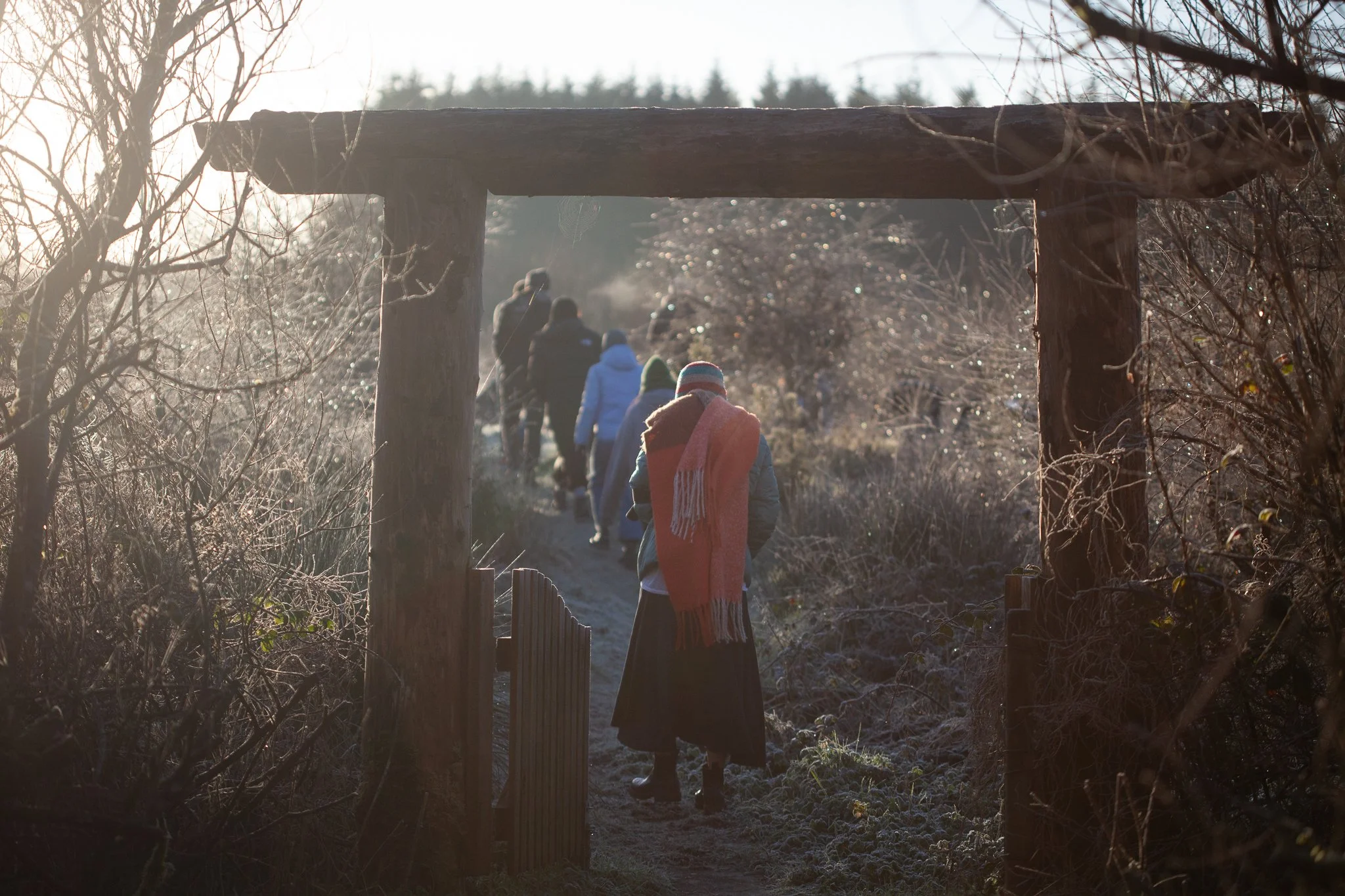
Photo by Caitriona Rogerson
You can listen to this story below (10 mins)
The Burren landscape is full of cracks. Fractures and fissures divide the limestone, which, as we walked across the stone slabs on a cold, crisp January morning, were rendered both beautiful and dangerously slippy. The light that morning was as if Yeats himself had laid down the heaven’s embroidered cloth, but we were also were being warned: thread softly.
We had gathered as part of the Suas/ Stand Changemakers Academy, a 6 month learning programme designed to support young changemakers with the learning required to both navigate the fractures and fissures of our world, and gain skills to build, repair and advocate for a better one. I have been fortunate to be a part of the design of the programme and was now in attendance as a facilitator at their Winter School through my work with Thrive School. Our home base for the week was Common Knowledge, a regenerative learning centre, rooted in the Burren. On this wintery morning, as the rocks and cracks told their ancient story, we were being guided on a place-based learning walk with Áine Bird, from the Burren Beo Trust, another organisation which seeks to connect people to the landscape and its care.

Photo by Caitriona Rogerson
Bearing the fossilised memory of millennia, on first glance it can be easy to read the story of the Burren as one of erosion, but, as Áine points out to us, on deeper reading, it also tells a story of protection, conservation and preservation. What we learn instead is that the system in which the landscape evolved is a complex interweave of narratives: human, ecological, agricultural, religious and cultural. To understand the full, systemic story, we must understand the relationship between the layers.
‘Live in the layers’, another poet, Stanley Kunitz has counselled, and so: the layers. When we put on an ecological lens we learn that the fissures are home to some of the rarest plants and insect life in the country. As the rest of Ireland becomes increasingly depleted of its biodiversity, it is landscapes such as this that become both habitat havens and critical species preservation hubs.

Photo: Clare Mulvany
Next layer: reading the landscape as a sacred text, we learn of the large cycles of worship which have played out on its altar. From pagan rituals, to early christian oratories, from holy wells and places of pilgrimage, time and ceremony have marked meaning and myth into the stone. With eyes in search of the sacred, we see the sacred.
Then with the eyes of an agriculturalist, we learn of the complex, interconnected relationships between man, bovine, plant and place; how the landscape- this place of sanctuary for marginal and rare species only is because of relationship. Take the cow, for example. As the wintering herds graze, keeping back potentially encroaching hazel bush, so too do they distribute seeds and nutrients to enable the flowering of rare spring bloom. Wild flower meadow and cow literally sustain each other. What dies, becomes, and what becomes feeds a wider circle of life. The key is in finding a balance between the elements: hazel bush, grazers, cows, plants and the right timing of the seasonal movement of herds to enable the plant life to flourish. Here communication is transhuman- man, animal, plant and place all in dialogue in to ensure mutual flourishing.
Next layer. With the eyes of the historian, in a single frame we can see the parallel of past and present. The mounds of an ancient Fulacht fiadh- thought to be an old cooking pit, now sits adjacent to a concrete watering trough for cattle. Just out of frame, there is also a famine house, its crumbling walls telling part of the larger story of how a community faded into decline through the systemic interplay of colonialism, economy, land rights and food sovereignty.
Each layer offers more readings. Each reading, brings up its own set of questions. The landscape is a living text, only fully decoded with open eyes, open minds and open hearts. So, in a complex layered system, and particularly as changemakers, we need to ask questions which probe into each layer, questions such as: Whose needs do you prioritise? Whose wellbeing is centred? What story is given voice? Who is not being heard? Without understanding the layers and characters in the narrative, we risk telling, and preserving, only a partial story. Story, we learn, is central. Without story, we may just fall through the cracks.

Photo: Clare Mulvany
Over the few days of the Winter School, I see the participants getting to know each other better, and being in this layered learning together. I can’t help but play with the landscape as metaphor too. The Winter School has become a haven in the fissures of our global fracture. Here are 22 participants gathering to pause, learn, regenerate. They represent 15 nationalities. There are singers and scientists, social entrepreneurs and sociologists. There is a medic from South Africa, a young family from Afghanistan. They are from Palestine, Cambodia, Nigeria, Japan, Germany, India, Ireland. They are all people who want to be part of writing a new story: This is Ireland. This is us.
We begin our days in circle. The circle is a container to hold the learning and each other, as we meet our edges and our hopes. I invite in our difficult questions, and our uncomfortable quests. How can we learn to navigate them if we can not support each other to be brave enough to ask them. Our questions are so we may learn to move through the layers of self and the systems we inhabit, to live more vitally and more fully, for all of us.

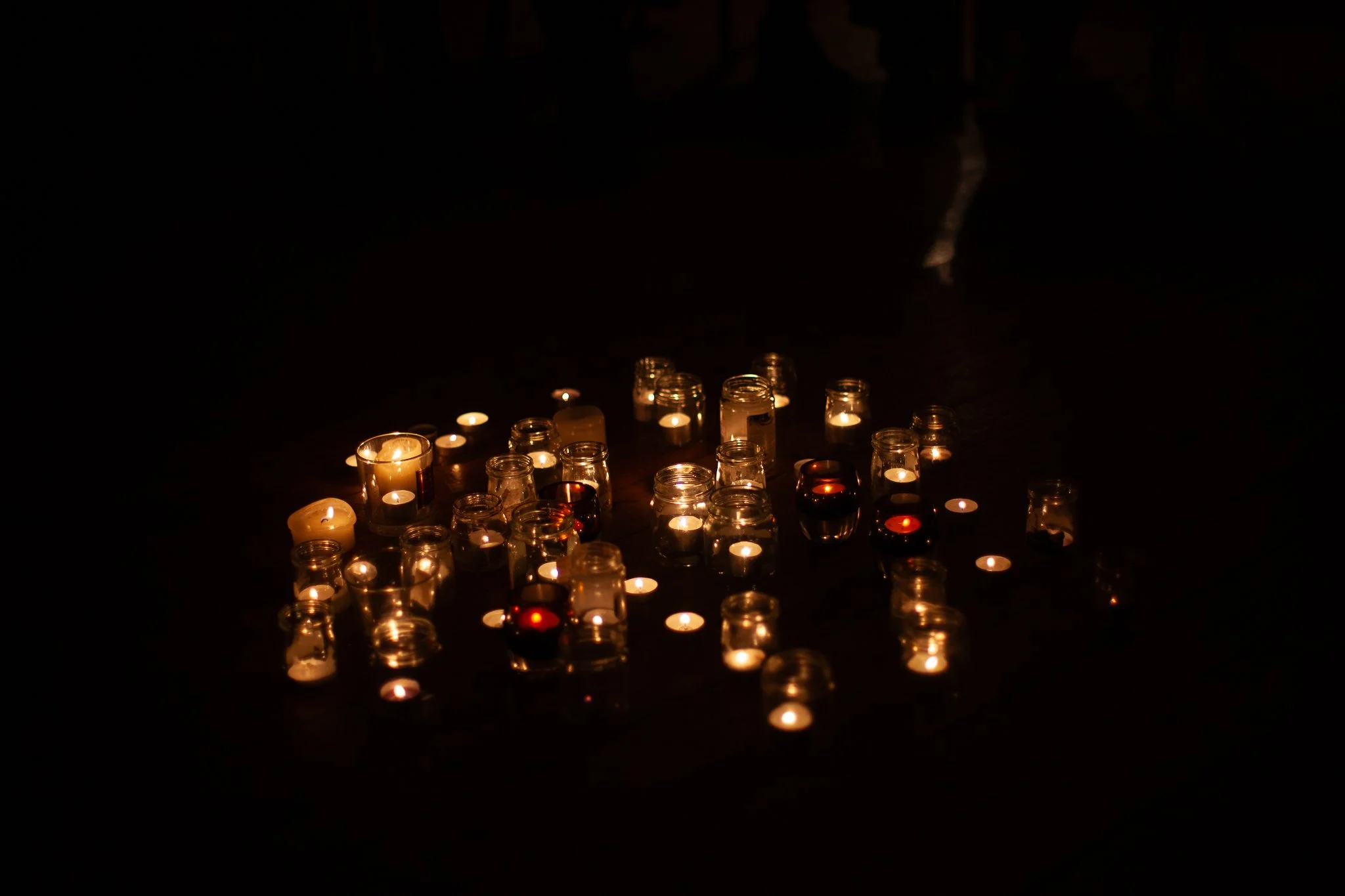
On our opening night, as the winter light falls back to a breathing dark, we light a gathering of candles in the centre of our circle. It’s an acknowledgment of the darkness in our systems, in our midst. A soulful young man from Palestine reads a poem from his people, in English, then in Arabic. The poetry travels as remembrance and witness. We leave the silence rest for a few moments, then we give the night to poetry.
The poetry salon comes into shape by way of gathering around candlelit tables. I speak a little to how poetry can open us up to insight and meaning making, which otherwise may remain out of view. I’ve choose a selection of poems which speak to the inner quest for purpose and value, and how we may travel. ‘Start close in’, came words from David Whyte, words which teach us how and where to listen. ‘To know kindness as the deepest thing inside, we must also know sorrow as the other deepest thing’, offers Naomi Shihab Nye. But let us not forget to rise, says Maya Angelou, nor forget to feast on our lives, reminds Derek Walcott. As each poem arrives, the salon participants share their responses. They speak to the questions the poems deliver or expose, and to the memories the words may evoke. Poetry is opening a door, and we step through.

Over the few days there is also project work. The participants have been assigned teams, and given challenge briefs by a range of community partners. They learn about design thinking and root cause systems work to build solution prototypes. There is an ideas to action cafe, to help them design and evolve their own personal projects too- a project which will nudge them to develop the changemaking skills they are seeking to strengthen. Then we add a buddy system to help sustain the process beyond the School.
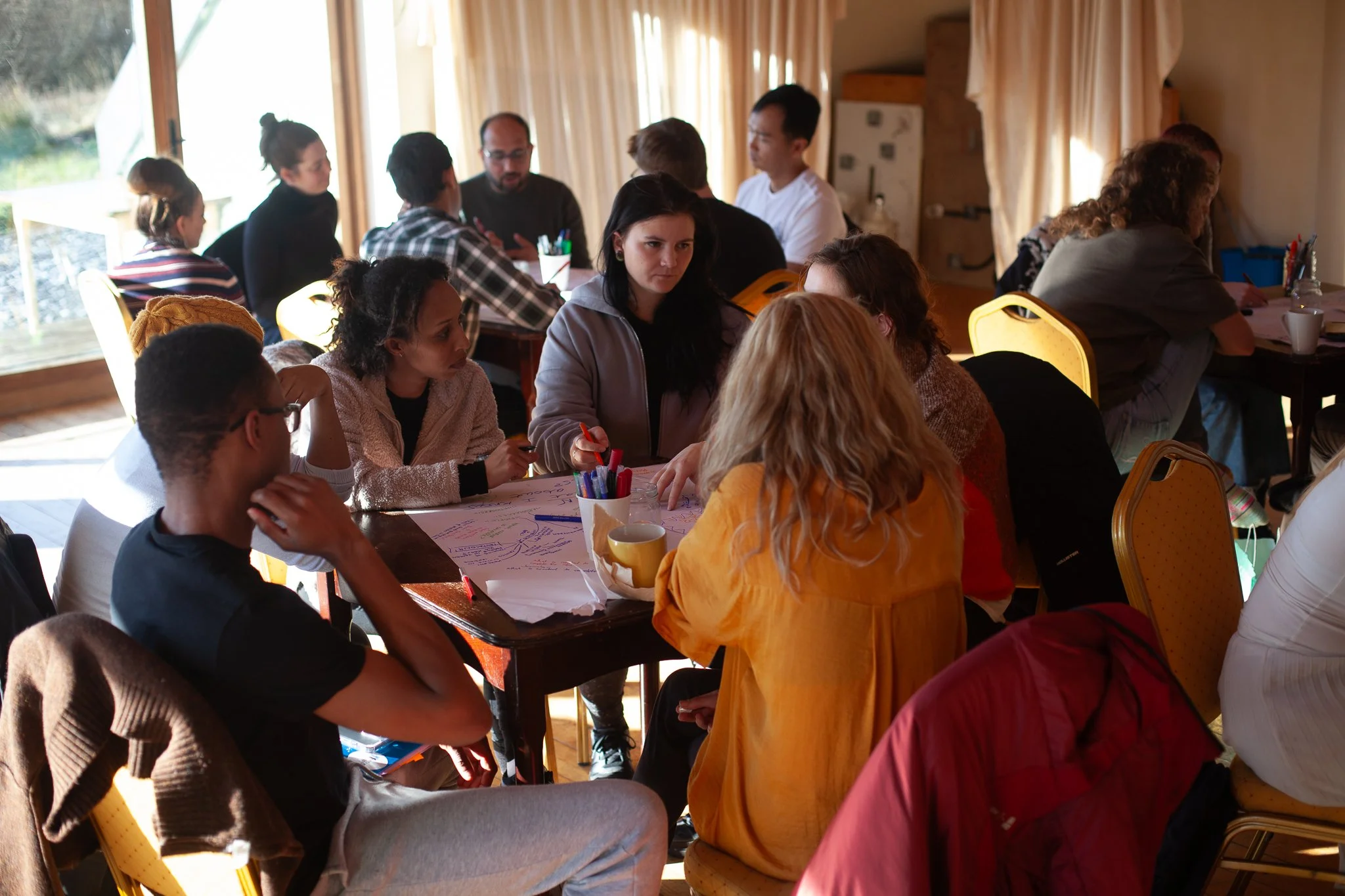
Another morning, still threading softly, we go on a silent Imram- a mythic Celtic walk out into the layered landscape which helps us listen to ourselves and our questions more fully. ‘Everything is connected’, says a participant as she begins to see in relationship and not in silos. ‘When I am quiet, memories can rise’, says another as he gets in touch with the regenerative power of nature’s wisdom, and it’s beautifully dangerous awakening too.
Then there are games and laughter, and career talks and delicious food, and by night, we fall back to story and song. Inspired by The Moth Storytelling movement, we tell stories of rupture and relief, of courage and confidence, and even some of pure embarrassment. The stories are torches, illuminating pathways of connection. Later there is a night of song and dance, and making room for what happens when we feel free to offer whatever talents or gifts are seeking to be shared.
Everything is connected, yes, and so are we.

Photo: Caitriona Rogerson

That winter morning as we walked down from the Burren with the light cascading in ribbons of honey and awe, careful of our footing, Yeats words came back to me, and I spoke them aloud.
Had I the heavens’ embroidered cloths,
Enwrought with golden and silver light,
The blue and the dim and the dark cloths
Of night and light and the half-light,
I would spread the cloths under your feet:
But I, being poor, have only my dreams;
I have spread my dreams under your feet;
Tread softly because you tread on my dreams.
My dream, I realise, is this new story in the making. As we thread softly alongside the fissures and the cracks, as these young people, and myself, learn to listen to the layers of story, as we try to build the skills, and moral muscle to straddle the divides, I can’t help but feel expanded, connected. The dream is in the layers and in the rising. The dream is in the writing and the telling. But it’s also in the circle, with a light at the centre. And they are it. We can all be it. It’s all connected.


Hello. I'm Clare
I'm a writer, educator and facilitator, living in beautiful West Cork, Ireland. I love to share resources and learning to help harness the regenerative power of words, place and story. I hope my work offers nourishment for mind and soul. Thank you for being here. Clare x

A Winter Blessing
Under candlelight and flicker, guided by the spirit of poetry, and the tradition of Celtic Blessings, a group of Poetry Salon participants created a collective blessing for the world. In an act of daring, gentle beauty, as each participant was reading their line aloud, I imagined the ripple effect of their compassion and care spreading out, illuminating pathways through these dark times.
Below the blessing, with an invitation. What line would you add?
Here was ours, written on Winter Solstice, December 21st 2023, with participants from Ireland, UK, Spain, Portugal, US, Belgium and Switzerland
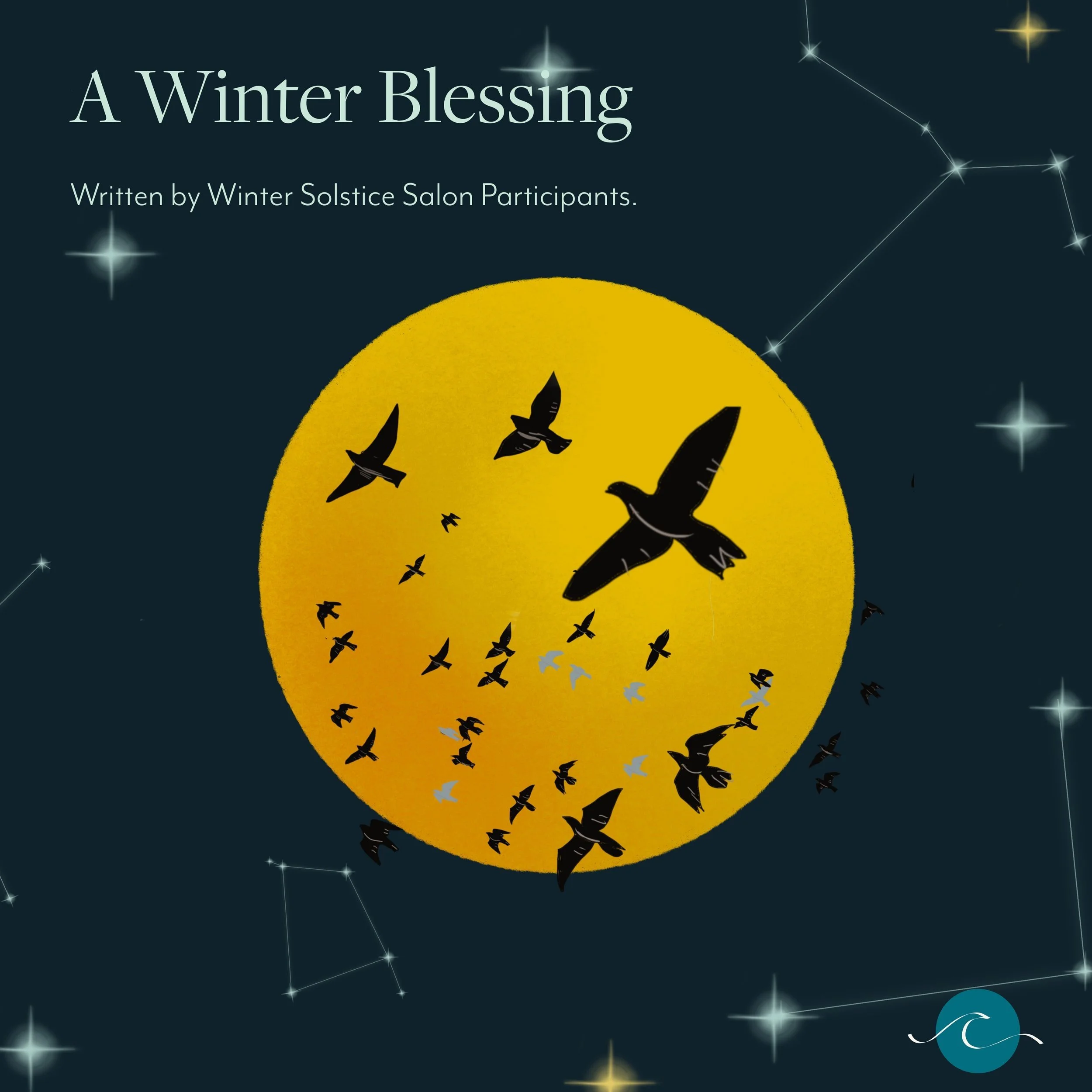
Under candlelight and flicker, guided by the spirit of poetry, and the tradition of Celtic Blessings, a group of Poetry Salon participants created a collective blessing for the world. In an act of daring, gentle beauty, as each participant was reading their line aloud, I imagined the ripple effect of their compassion and care spreading out, illuminating pathways through these dark times.
Below the blessing, with an invitation. What line would you add? (you can add in the comments below)
Here was ours, written on Winter Solstice, December 21st 2023, with participants from Ireland, UK, Spain, Portugal, US, Belgium and Switzerland.
Collective Blessing, written by Salon participants
May we allow ourselves rest in the “in between”.
May we remember that we belong to each other.
May we honour the self in ourselves and each other.
May we be the mystery keepers at the crossroads of our senses.
May we pull down the curtain embroidered by those who would keep us apart to quell our power.
May our current darkness birth life and light in the world and in us.
May the people of Gaza have clean water, shelter, medical care, enough to eat and freedom to live without bombs.
May the cycles of life fall gently on you, may your storms be few with many shelters.
May we all the remember our hearts being blessed.
May we accept the protection of our wild waiting kin.
May there be light to open humanity’s dark mind and see what really is.
May we become a sanctuary for ourselves and for others.
May we all turn towards the love in our hearts, and from this place of peace, bless love as the guiding force in the world.
21 December, 2023.
Hello. I'm Clare
I'm a writer, educator and facilitator, living in beautiful West Cork, Ireland. I love to share resources and learning to help harness the regenerative power of words, place and story. I hope my work offers nourishment for mind and soul. Thank you for being here. Clare x
Available Now
An Intentional Year
Focus on what matters most, and create an intentional 2024. Guidebook and an Intentional Year course now available
Hand Washing
Hand washing
The water from the tap is warm,lapping over my palm,as a waterfall would, or the accumulationof tears left unspoken,marking patterns of erasure onthe minuscule, the microscopic,my way of clearing a new field for planting.On the other side of fearthere is always an invitation.My hands turn and shift underthe liquid soap,gliding as if a swan is gracefullyopening her wings, saying:this span of life is precious,and we are only just learningto fly as a flock.I listen to the running water,and enter a sound bath,easing this body into the ritual ofablution;it’s a resurrected prayer, turning my palmstowards the sky, fingers dancing.This is my way of reaching out now,to touch that slender film of togethernesswhich has always held us,only these days, under this flowing water,we get to touch each other clean.In the space just beyond me,in the quiet empty of my chosen isolation,I can feel your skin under this water too,and I am reaching for your hand,you stranger,who I may never touch:your soul is cupping this water,your clear breath is my dream,your destiny is in my hands too.The tap runs clear for us all.Yes, on the other side of fear,there is always an invitation:What will we plant with our clean,dancing hands?Our field is readyand I hear there are harvestswaiting to grow.- Clare Mulvany, 23 March, 2020
A letter to Mary Oliver
 A Letter to Mary Oliver, with thanks. You have passed on, but your words have not. I think there is an extra chamber in my heart where they fully inhabit, pumping wonder and beauty into the places in my being which need them the most. I know your words circle in others peoples hearts too, lining them with awe, and grace, and now an infinite beat of gratitude. We have much to thank you for. You let your words rest on blank pages, arranged in configurations of strange symbols which we place together as consonants, then poems. But your configurations have a special quality, something rooted and ethereal at once. More constellation than star, more forest than seed. We could say your poems carry the touch of mystery, but I think you’d call it love instead; that your pen was a point of capture and your words a place of gathering, so we can see it more clearly, in the grass and the way light falls daily, or the way a cricket carries its song. You reminded us that it is all love really, this earthly presence of being, this wild and precious life. Little did you know it Mary, but for more than half my life, since I first read your poems, you have come everywhere with me. I’ve packed you in my backpack and we have travelled the world. I’ve taken you on bus journeys, planes journeys, ferry rides and long undulating walks. We’ve stayed up late at night with a torch under the bedcovers. Do you remember the time when we on a beach in Greece reading poems to the sea? Or the time when my little dog sat beside me and I read your dog poems aloud to her? Or the multiple nights on my yoga mat, when you’d tuck into position by my side, and tell me, over and over, to trust in the way of things. You’d let me cry tears if needed, whether of joy or sadness, and you’d always wipe them with beauty. You have been my companion in dark corners and tunnels which I thought would never end. Your words, the best of friends. Your poems, a lighthouse. ‘You do not have to be good’, you whispered to me in one particular dark patch’, ‘you only have to let the soft animal of your body loves what it loves’. That became my mantra, recalled with regularity and devotion.You have given instructions for living a life. ‘Pay attention, be astonished, tell about it’. In this, I can say, I am trying. And you have reminded me that the 'boxes of darkness can also be gifts'. I open them differently now. You have said the world offers itself to our imaginations, no matter who we are, no matter how lonely. So you have been training me to seek the imaginative possibility. Belong to this world, you suggested, and give yourself to it, ‘married to amazement’. In this I can say I am wed, only my vows need to be renewed daily. Your poems take me there. You have spared me the worry of haste and urgency. ‘Don’t worry’, you say, ‘things take the time they take’. And then you offered me one question which thread so close that is has changed everything. ‘So, tell me, what is it that you plan to do with your one wild and precious life?’. I wake up with those words on my lips and each day I long to live into them. It it the best kind of quest. Yours was wild, yours was precious, and you have made mine all richer through the gifting of your gift. I hope to thank you in the pay it forward kind of way, in a way I think you’d like, with the simple gestures of love, and a heart seeking always to speak to the wonder of it all. Rest in peace dear Mary Oliver. May your words work their infinite wonder in the hearts of many more, With love and eternal gratitude. Clare.xx
Poetry Circle- A Radical Salon for our Time?
 You can listen to this post here too:
 The circle of the year is turning. As the leaves fall back home to the earth, and the evenings begin to turn in on themselves, there is a signalling to gather. Inwards.The fire is lit. The poetry books are scattered around a low coffee table. The invite had been sent a few weeks previously. The season of the poetry salon is upon us. Now, all there is left to do is light some candles, and wait. ‘Whoever comes are the right people’, ‘Whenever it starts is the right time’. I reiterate some gathering guidelines I learned through the Art of Hosting community. They remind me that once an intention is set, once the foundations have been laid with beauty, beauty can only be braided deeper, whatever form it takes. This is not about numbers, after all, but about the act of gathering, and listening, and leaning into the space between friends and strangers, with poetry as the gateway and the salon as the template.Lady Wilde, or ‘Speranza’ was a woman who lived up to her name, or so the accounts of the 1860s would have us believe. Oscar Wilde’s mother, a poet, Irish nationalist, folklorist and passionate women’s rights advocate, was a gatherer and host of one of the most notorious and flamboyant Dublin salons. Number One Merrion Square, grand and elegant, opened its doors to the literati, musicians, artists, social commentators, medics, law makers and perhaps law breakers, of the time. Under candlelight they gathered to discuss a gamut of affairs and culture. W.B Yeats, Ruskin and suffragist Millicent Fawcett, were all said to have crossed the door, with a young Oscar Wilde listening in from the alcoves.
  Lady Wilde’s salon was not in isolation. Across Europe, from Italy to France in the 17th and 18th centuries, salons were places for the circulation of ideas, knowledge and conversation. Often hosted by women, the salon was a ground for the development of an active civic and public life. We can assume these gathering places were not always sober, and not necessarily always civil, but they did create public places for the gathering of difference, for dialogue and debate outside the formal realms of either church or state. They brought together the intersections of disciplines and sectors, where the rules of one did not outweigh the rules of another. Put a woman in the centre of things, especially in those times, especially in Ireland, and here are the ingredients for ripe and radical activism. Here was a way to do things differently.We have Twitter now of course. And we have digital discussion rooms. But here we also have the digital infrastructure for polarisation and fraction to escalate. We have fear, and worse still, fear mongering. The institutions which one held the power and prestige are crumbling around us and in many cases, rightly so. But I question the spaces in which ‘conversations’ are happening. I watched the recent Presidential debates in Ireland for instance, and I wondered, ‘Where is the room for genuine listening? Where is the room for robust debate, unpinned with respect, and dare I say it, perhaps the most radical word of all, love. There was a poet in the midst too, running for re-election, now under attack for caring to too much about things that do not have a direct economic value. Things like poetry, and things like dignity. Would we, as a nation, dare to listen?You find the respect in pockets of course, and the digital world can amplify those pockets. I find it with writers, like the environmentalist Terry Tempest WilIiams and Robert McFarlane, with social commentators like Rebecca Solnit, and I find it in online watering holes like BrainPickings and On Being, the latter offering us guidelines for convening with their ‘Grounding Virtues’. I love how words like ’Generous Listening’, ‘Adventurous Civility’, and ‘Humility’, are now active and explicit participants in this online space, values which I know spill over and enliven their public events. Here too: a template.Right out at the edge of Europe on the west coast of Ireland, my little home goes by the name of ‘Wren Cottage’. It’s no Number One Merrion Square, but it’s cozy and if there are not enough chairs there are always cushions and floor space. Knock on the door by knock on the door, a little flock gathers. Some have come before, some are new. Tea is made, more logs on the fire, and we make our way naturally into a circle. I mention briefly the history of the salons, thinking of Lady Wilde, and I make reference to On Being’s ‘Grounding Virtues’. There is not much need for small talk and soon the poetry takes over. By way of tradition, Mary Oliver opens, then Rilke joins the chorus. There are sighs of awe, and sighs of not knowing what to say because the poem is just beyond words. The poems leave trails around the room. Another participant picks up a scent and offers fresh language into the circle.Then we laugh and marvel at Sharon Olds’ poem about breasts, and we delight in the spaciousness in the language of the Chinese poet Zhao Lihong, a poet new to most of us. Convulsions of laughter ripple outwards in thinking about Rumi on a modern dating site. The laughter builds a deeper bond. The circle tightens.As the salon continues, I am aware of a friend of mine, attending an environmental conference in the US on the same weekend. It is a place for bringing together activists and changemakers. But he speaks of the fear in the room, and an intense anger too. He speaks of the deep deep grief for these times we are in, and a sense of paralysed frenzy. It makes us wonder, ‘What room for joy amidst such times? What room for beauty? And definitely, what room for poetry?’ A while later he sends me some words from another role model in our midst, the scholar and activist, Joanna Macy, on this thing called ‘Active Hope’;‘Active Hope is not wishful thinking. Active Hope is not waiting to be rescued by some saviour. Active Hope is waking up to the beauty of life on whose behalf we can act.. a readiness to discover the size and strength of our hearts, our quickness of mind, our steadiness of purpose, our own authority, our love of life, the liveliness of our curiosity, the unsuspected deep well of patience and diligence, the keenness of our senses, and our capacity to lead. None of these can be discovered in an armchair or without risk’.
  Around the circle the fire crackles and the flames spark. More tea is made. In my Celtic tradition, like so many indigenous traditions around the world, the circle was the primary shape of things. Stone circles. Fairy rings. In the shape of the circle is the container for the whole; fear and grief, joy and beauty. The circle holds both yin and yang, the masculine and the feminine, the light and the dark. It’s not a place for blind optimism, wishful thinking, nor deepest despair. Instead is a place to return those things back to their wholeness with a singular message: we are in this together.I am interested in the intersections of things: ‘Where do you end and I begin?; Where does fear become courage?; Where do the arts become activism?; Where does beauty simply beget beauty and joy beget joy? In dark and challenging times, I’m with Joanna Macy on this: there is a radicalism in insisting on beauty and joy, for the very amplification of those things. Yes: Active Hope.With that we get to ask questions like this: What if we didn’t need more platforms for opinions, but more platforms for presence and connection instead? What if our presidential candidates were seated in a circle, grounded in virtues and invited first to listen, then to speak. What if instead of defending a position, they were asked to defend their values? Then read a poem.Last week, the Irish nation took to the polls. The poet was re-elected. Our president speaks of the power of words, and values. ‘We are in a time of transformation and there is a momentum for empathy, compassion, inclusion and solidarity which must be recognised and celebrated’, Michael D Higgins said at this acceptance speech, ‘Words matter. Words can hurt. Words can heal. Words can empower. Words can divide’.The thing is this: people got up from their armchairs. They voted. They dared. Not all of us, not enough of us, but enough to #keepthepoet . Enough to insist on words mattering, and dignity too.Back around the fire our poems circled and circled. Towards the end of the evening, my friend Orlagh suggested we each write a question on a post-it note. Any question, any question at all. Then we’d gather those questions to see how they converge. A few minutes later there is a shriek at the back of the kitchen where Orlagh is curating the post-it’s as an archivist would, or an archeologist. Two of us have written the exact same question. ‘Where does poetry come from and where does it go to?’ And the other questions? Well this is what emerged; a poem, written by the whole, from our wren circle:
Where do poems live when the book is closed?Why does the light on the sea always stretch towards you,following, following?Why do the stars stare?Where does poetry come from and where does it go?If the news showed poems instead of the tragic, what would the world become?When is the Tao not the Tao?Only in the forgetting of love.Do I dare?
Around the circle, awe rolls out into the night with hints of laughter and impossible delight. I can feel Lady Wilde smiling from the great beyond, and Oscar Wilde listening in from the alcoves. This thing we are in together? We think it might be magic. If only we can get out of our way long enough to get out of our armchairs and hear the poetry of the world rising. I think the circle might just be our ears. And the salon? Well that’s up to you. Now you have a template. Go. 
...
Want to stay in touch?
Sign up to my newsletter for news, happenings and more writings.
Poetry Salon 5
 Hello everyoneOn tonight's episode of The Poetry Salon we are on a journey across the world, to India and then to Rwanda, encountering voices and poems which we don't often encounter.So, pull up a chair and take 15 minutes to listen to the voices of children and young adults who have some very powerful words to offer ushttps://soundcloud.com/claremulvany/poetry-salon-5-december-2017You can listen to previous episodes of The Poetry Salon over on my soundcloud page here.Happy listening!Clare x
Poetry Salon // 3
You can listen to Episode 3 here.  Have you ever felt lost, homesick, wondering if you will ever find your way?Here in this third episode of the poetry salon I explore poetry as a map to help us find our way back to our inner and outer worlds.Today with the help of encounters with Seamus Heaney, David Whyte and David Wagoner- some a little more literal that I would have liked!Total running time: 14 mins.Hope you enjoy and would love to hear what poems have been maps for you over the years.Clare xx Want to catch up with other episodes: Episode One: Poetry as communal act and the introduction of the salon, with poems by Mary Oliver and Rachel Holstead. Listen here Episode Two: Poetry as lineage- and a cauldron of childhood memory. With rhymes from my Nana, a poem from my Dad, and a poem which took me into political awareness. Listen here. ...
Want to stay in touch? Sign up to my 'Notes from the Edge' for more creative resources and tools for living your one wild life.
Letters from Clare
Stay in touch…
@onewildlife
Follow Along